
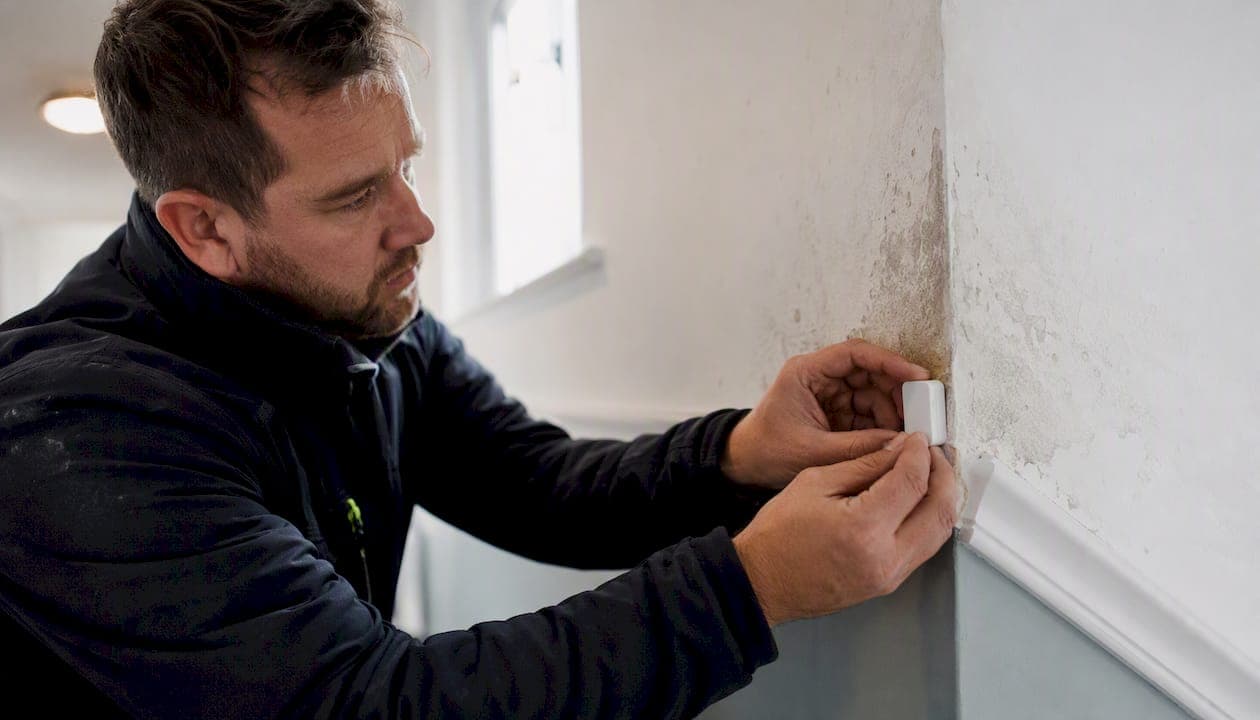
From 27 October 2025, every registered social landlord in England must investigate potential hazards, complete relevant safety work, and provide tenants with a written summary of findings — all within prescribed statutory timeframes. Miss a deadline and you face court action, Housing Ombudsman scrutiny, and regulatory intervention. The law does not wait for your next planned inspection cycle.
Phase 1 is already in force. Phase 2 follows on 30 November 2026, expanding the hazard list significantly. The window to get your processes right is now.
Immediate actions every frontline team must take from day one of a report:
- Record the date and time of first awareness (this is "day 0" for emergency hazards; standard clocks start the following day)
- Triage the hazard as emergency or significant using all available tenant information
- For emergency hazards: begin investigation and relevant safety work within 24 hours
- For standard hazards: complete investigation within 10 working days
- Issue a written summary of investigation findings within a few working days of the investigation concluding
- Complete relevant safety work promptly after the investigation concludes
- Begin supplementary preventative work within a short period after relevant safety work, or within a longer timeframe if immediate start is not possible
- Offer temporary rehousing where the property is unsafe to occupy
- Log every decision, contractor instruction, and tenant communication with a timestamp
These are not targets. They are statutory requirements under the Hazards in Social Housing (Prescribed Requirements) (England) Regulations 2025, and tenants can take court action for breach.
Key takeaways
Awaab's Law compliance requires landlords to investigate, document, and repair within fixed statutory timeframes from the moment of awareness, with Phase 1 already in force and Phase 2 expanding the hazard list from 30 November 2026.
| Point | Details |
|---|---|
| Phase 1 already applies | Emergency hazards and significant damp and mould have been in scope since 27 October 2025 |
| Core timeframes are fixed | 24 hours for emergencies; 10 working days to investigate; 3 working days for written summary; 5 working days for safety work |
| Audit trail is non-negotiable | The Housing Ombudsman examines timestamps, triage decisions, and tenant communications — not just whether the repair was done |
| Phase 2 gap analysis is urgent | From 30 November 2026, excess cold, falls, fire, electrical, and structural hazards join the scope; contractor panels and triage forms need updating now |
| Tricitylabs Verity | Provides continuous, time-stamped monitoring data that supports triage decisions and produces exportable audit evidence for Ombudsman reviews |
Table of Contents
- 1. Who and what does Awaab's Law cover in England?
- 2. Statutory timeframes: what the clocks actually say
- 3. How do you triage emergency versus significant hazards?
- 4. Step-by-step operational workflow from report to completion
- 5. What records do you need, and how do you build a defensible audit trail?
- 6. Governance, resourcing and KPIs to sustain compliance at scale
- 7. Enforcement routes, complaints handling and legal risk management
- 8. Preparing for Phase 2 from 30 November 2026
- 9. How independent continuous monitoring supports triage and compliance evidence
- 10. What implementing Awaab's Law actually teaches you about your own processes
- Verity gives your compliance evidence a timestamp the Ombudsman can rely on
- Sources
1. Who and what does Awaab's Law cover in England?
Awaab's Law applies to all registered providers of social housing in England, including local authority landlords and housing associations. Private landlords are not in scope. If your organisation holds a registration with the Regulator of Social Housing and lets residential properties under a social tenancy, you are bound by these requirements from Phase 1 onwards.
Which homes are covered?
The duties apply to dwellings let under social tenancy agreements. There is no minimum or maximum property size threshold. Shared ownership properties and supported housing units let on social tenancies are included.
Which hazards are in scope?
- Phase 1 (from 27 October 2025): Emergency hazards of any type, and significant hazards specifically relating to damp and mould
- Phase 2 (from 30 November 2026): Emergency hazards of any type, plus significant hazards across the full expanded list (excess cold, excess heat, falls, structural collapse, fire, explosion, electrical hazards, and domestic hygiene)
A hazard is in scope when it arises from a deficiency that is the landlord's responsibility to remedy, and when it meets the threshold of "significant" or "emergency" as defined in the Regulations and supporting guidance.
Quick scope checklist for first contact:
- Is the landlord a registered provider of social housing in England? ✓
- Is the property let under a social tenancy agreement? ✓
- Does the reported deficiency fall within the landlord's repair obligations? ✓
- Does the hazard appear potentially significant or emergency based on initial information? ✓
If all four answers are yes, Awaab's Law applies and the statutory clock has started.
| Point | Details |
|---|---|
| Who is in scope | All registered providers of social housing in England, including local authorities and housing associations |
| Phase 1 hazards | Emergency hazards (all types) and significant damp and mould from 27 October 2025 |
| Phase 2 hazards | Expanded list including excess cold/heat, falls, fire, electrical hazards from 30 November 2026 |
| Trigger condition | Deficiency within landlord's responsibility, classified as significant or emergency |
2. Statutory timeframes: what the clocks actually say
Every statutory deadline under Awaab's Law is fixed. There is no discretion to extend them unilaterally, and the GOV.UK guidance on timeframes is explicit: these repairs must not be folded into long-term capital programmes or cyclical maintenance schedules. They require separate, hazard-specific handling.
| Obligation | Timeframe | Notes |
|---|---|---|
| Emergency investigation and safety work | Within one day from awareness | Clock starts immediately, not the following day |
| Standard investigation | Within about two weeks from awareness | Clock starts the day after awareness ("day 1") |
| Written summary to tenant | Within a few days after investigation concludes | Must be delivered by specified method |
| Relevant safety work | Within about a week after investigation concludes | Applies to both emergency and standard tracks |
| Supplementary preventative work (start) | Within a few days after safety work, or by a longer timeframe if not immediately possible | Must be begun, not necessarily completed |
How "day 1" is calculated: for standard hazards, the clock starts the day after the landlord first becomes aware of the potential hazard. If you receive a report on a Monday, Tuesday is day 1 and the 10-working-day investigation window closes at end of day the following Monday (excluding weekends and bank holidays). For emergency hazards, the 24-hour window begins the moment awareness is recorded, with no overnight grace period.
Phase 1 vs Phase 2 coverage:
- Phase 1 (27 October 2025): all timeframes apply to emergency hazards and to significant damp and mould
- Phase 2 (30 November 2026): the same timeframes apply to the full expanded hazard list
The Phase 2 guidance also clarifies how the hazards annex should be used to support triage decisions across the wider hazard set.
Pro Tip: Set your case management system to calculate deadlines automatically from the timestamp of first awareness, not from when a job is raised. The two can differ by hours or days, and the Ombudsman will check the earlier date.
3. How do you triage emergency versus significant hazards?
Triage is where compliance is won or lost. A wrong classification on day 0 can put you in breach before a contractor has even been instructed. The Phase 2 guidance and hazards annex provide the definitional framework; your frontline staff need to apply it in real time.
Definitions in brief:
- Emergency hazard: a hazard that poses an immediate risk to the health or safety of the occupants and requires urgent intervention within 24 hours
- Significant hazard: a hazard that poses a risk to health or safety but does not require immediate emergency action; it still triggers the 10-working-day investigation and subsequent repair obligations
What to gather at first contact:
- Tenant's description of the defect (location, extent, duration)
- Number and ages of occupants, particularly children under five or elderly residents
- Any known health vulnerabilities (respiratory conditions, immunosuppression, mobility issues)
- Whether the affected area is a bedroom, bathroom, or living space (higher risk if sleeping area)
- Whether the tenant has already attempted any remediation (ventilation, heating)
- Photographic evidence if the tenant can provide it immediately
- Whether the property is currently habitable
Scenario examples for damp and mould (Phase 1):
A child aged three with asthma lives in the room. This is likely a significant hazard at minimum; the presence of a vulnerable child with a respiratory condition may push it to emergency depending on extent and access to alternative sleeping space.
Scenario B: A tenant reports a small patch of mould (approximately 10cm x 10cm) on an external bathroom wall, no vulnerable occupants, good ventilation. This may fall below the significant threshold, but still requires documented assessment and a decision with a timestamp.
The difference between these two scenarios is not just the mould. It is the occupant profile. Triage must account for both.
When to escalate to an in-person inspection: if the information gathered at first contact is insufficient to make a defensible classification, the guidance requires an in-person inspection within the standard 10-working-day investigation window. Do not delay the investigation clock while waiting for a convenient appointment.
Pro Tip: Build a structured triage form into your contact centre and repairs portal. Every field should map to a triage decision criterion: occupant age, health vulnerability, hazard location, extent, duration. A completed form is your first line of evidence if the Ombudsman asks why you classified a hazard the way you did.
4. Step-by-step operational workflow from report to completion
The workflow below maps each statutory obligation to a responsible role and a deadline. It is designed to be embedded directly into your repairs and case-management system.
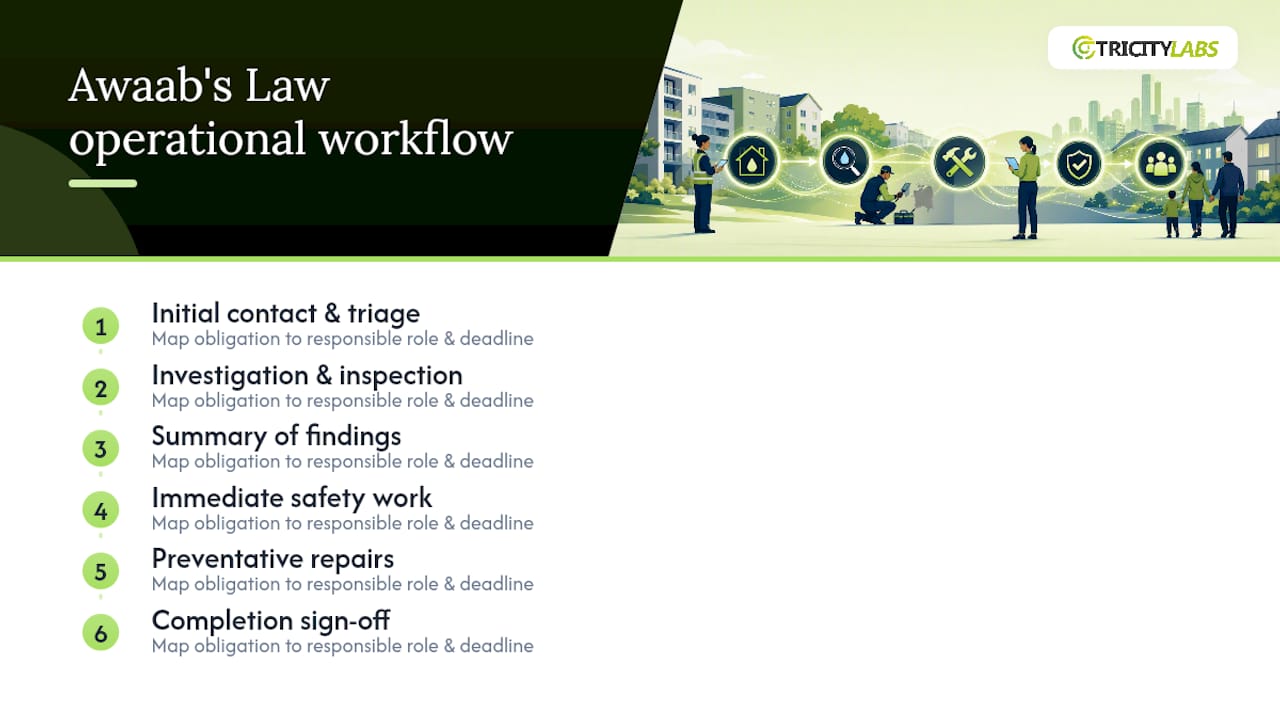
Step 1: Initial contact and triage (day 0)
Who: Contact centre agent or repairs officer Actions: Record date and time of awareness; complete triage form; classify hazard (emergency / significant / below threshold); if emergency, immediately instruct contractor and open 24-hour clock; if significant, open 10-working-day investigation clock; notify tenant of next steps in writing
Step 2: Investigation (days 1–10 for standard; within 24 hours for emergency)
Who: Investigation lead (surveyor or qualified officer) Actions: Conduct physical inspection; gather environmental evidence (photographs, moisture readings, sensor data where available); assess root cause; determine whether safety work is required; document findings with timestamps
Step 3: Written summary (within 3 working days of investigation concluding)
Who: Investigation lead or case manager Actions: Prepare written summary containing: what was found, what action will be taken, target timescales for safety work and preventative work, and contact details for queries; deliver by one of the specified methods (personal handover, left at property, first-class post, or electronic transmission)
Step 4: Relevant safety work (within 5 working days of investigation concluding)
Who: Repairs officer and contractor Actions: Instruct contractor with explicit reference to the statutory deadline; record contractor instruction timestamp; confirm completion with photographic evidence and a signed completion record; update case file
Step 5: Supplementary preventative work (within 5 working days or 12 weeks)
Who: Asset manager and contractor Actions: Identify root-cause remediation required (e.g. insulation, ventilation, structural repair); schedule work; record start date as evidence of compliance; update tenant on timeline
Step 6: Completion sign-off
Who: Compliance lead or housing manager Actions: Review case file for completeness; confirm all timestamps are recorded; close case in management system; flag for post-completion monitoring if recurring hazard
Responsibility matrix:
| Role | Responsibility | Deadline |
|---|---|---|
| Contact centre agent | Triage, classification, clock start | Day 0 |
| Investigation lead | Physical inspection, findings documentation | Day 10 (standard) / 24 hours (emergency) |
| Case manager | Written summary preparation and delivery | 3 working days post-investigation |
| Repairs officer | Contractor instruction and safety work oversight | 5 working days post-investigation |
| Asset manager | Preventative work scheduling | 5 working days or 12 weeks post-safety work |
| Compliance lead | Case file review and sign-off | At completion |
5. What records do you need, and how do you build a defensible audit trail?
The Housing Ombudsman will examine your records to check whether reports were recognised and handled appropriately. "We did the work" is not enough. You need to show when you became aware, what you decided, why you decided it, and what happened next, all with timestamps.
Required fields for an investigation record:
| Field | What to capture |
|---|---|
| Date and time of first awareness | Exact timestamp; source (phone, portal, email, sensor alert) |
| Hazard classification | Emergency / significant / below threshold, with rationale |
| Triage evidence | Occupant details, vulnerability flags, hazard description |
| Investigation date | Date of physical inspection or remote assessment |
| Findings summary | Root cause, extent, affected areas, environmental readings |
| Action plan | Safety work required, preventative work required, timescales |
| Written summary delivery | Method used, date sent, confirmation of receipt where possible |
| Contractor instruction | Date, contractor name, scope of work, statutory deadline communicated |
| Safety work completion | Date, photographic evidence reference, completion certificate |
| Preventative work start | Date begun, scope, projected completion |
| Tenant communications log | Date, method, content summary for every contact |
| Access attempts | Dates and outcomes where tenant access was not available |
Written summary: required content fields
The Regulations specify that the written summary must include: what was found during the investigation; what action the landlord intends to take; the target timescales for that action; and contact details for the tenant to raise queries. Acceptable delivery methods under regulation 10 are: personal handover to the tenant, leaving it at the property, first-class post, or electronic transmission (email or portal message).
Using the "reasonable endeavours" defence
Where a landlord cannot meet a statutory deadline due to circumstances genuinely outside its control (contractor unavailability, tenant access refusal, supply chain failure), the Regulations allow a "reasonable endeavours" defence. To rely on it, you must show: that you identified the hazard promptly; that you instructed a contractor within the statutory window; that you documented every access attempt and contractor communication; and that you kept the tenant informed throughout. A sparse case file will not support this defence. A timestamped audit log will.
Pro Tip: Store investigation records, written summaries, and completion evidence in a single case file linked to the property address and tenancy reference. When the Ombudsman requests a case file, you should be able to export it in under five minutes. If that is not currently possible, your recordkeeping system needs attention before a complaint arrives.
6. Governance, resourcing and KPIs to sustain compliance at scale
Awaab's Law compliance is not a one-off project. It requires permanent changes to how your organisation monitors, reports, and escalates hazard cases. The governance framework below is designed for housing associations and local authority landlords managing portfolios of any size.
Suggested KPIs for board and operational reporting:
- Percentage of emergency hazards investigated promptly
- Percentage of standard investigations completed within the required timeframe
- Percentage of written summaries delivered promptly after investigation
- Percentage of safety work completed within the expected timeframe
- Number of cases where the reasonable endeavours defence was invoked
- Rate of cases where the hazard recurred within the following year
- Average time from report to preventative work start
Role matrix for governance:
- Board: receive quarterly compliance dashboard; approve resourcing for surge capacity; review systemic failure reports from the Regulator of Social Housing
- Compliance lead: own the Awaab's Law policy; maintain the triage framework; report KPIs monthly; liaise with the Housing Ombudsman on active complaints
- Operations manager: manage day-to-day workflow; monitor case queues; escalate cases at risk of breaching deadlines; manage contractor panel performance
- Caseworker / repairs officer: execute triage, investigation, and repair instructions; maintain case file records; communicate with tenants at each stage
Training checklist:
- Induction training for all frontline staff: Awaab's Law scope, triage criteria, statutory timeframes, and recordkeeping requirements
- Refresher training every six months, updated to reflect any new guidance or Phase 2 changes
- Specialist training for investigation leads: hazard assessment methodology, use of the hazards annex, and evidence-gathering techniques
- Contractor briefings: statutory deadlines, completion evidence requirements, and escalation protocols
- Assessment: a short written or scenario-based test after each training module, with results recorded
Contingency planning for surge volumes:
Contractor shortages and high-volume reporting periods (post-winter, following media coverage) are predictable risks. Prepare now by:
- Maintaining a pre-approved secondary contractor panel with agreed Awaab's Law response terms
- Setting a surge threshold (e.g. more than 20% above average weekly case volume) that triggers automatic escalation to the operations manager
- Pre-drafting tenant communication templates for use when delays are anticipated
- Agreeing a temporary rehousing protocol with your housing management team for cases where properties become unsafe during a surge
7. Enforcement routes, complaints handling and legal risk management
Tenants have three routes to enforce Awaab's Law. Understanding all three is essential for managing legal risk.
Route 1: Court action for breach of contract
The Hazards in Social Housing (Prescribed Requirements) (England) Regulations 2025 imply a covenant into every social tenancy agreement requiring the landlord to comply with the prescribed requirements. A tenant who can show that a landlord failed to investigate, repair, or communicate within the statutory timeframes has a contractual claim. This is a direct route to county court proceedings, and damages can include compensation for health impacts and distress.
Route 2: Housing Ombudsman complaint
Tenants can refer complaints to the Housing Ombudsman Service after exhausting the landlord's internal complaints process. The Ombudsman will examine whether the landlord correctly recorded and assessed the hazard report, whether statutory timeframes were met, and whether communication with the tenant was adequate. Findings of maladministration can result in compensation orders and mandatory service improvement requirements.
Route 3: Regulator of Social Housing
The Regulator's role is systemic rather than case-specific. Where the Ombudsman identifies a pattern of non-compliance across a landlord's portfolio, it can refer the matter to the Regulator. The Regulator can impose regulatory judgements, require improvement plans, and in serious cases exercise enforcement powers under the Social Housing (Regulation) Act 2023.
Complaints and Awaab's Law run concurrently. A tenant who raises a formal complaint while a hazard is still unresolved triggers both the Housing Ombudsman's Complaint Handling Code timelines and the statutory repair deadlines simultaneously. You must satisfy both. Resolving the complaint without completing the repair does not discharge your statutory obligation.
Legal risk checklist:
- Offer temporary rehousing in writing when a property is unsafe to occupy, and document the offer and the tenant's response
- Record every contractor delay with a timestamp and the reason given; chase in writing and keep the email trail
- Retain pre-action correspondence (solicitor letters, formal complaints) in the case file alongside the repair records
- Never respond to a pre-action letter without first checking whether the statutory timeframes were met and whether the case file is complete
Practical steps to reduce litigation risk:
Early engagement is the single most effective risk mitigation. A tenant who receives a clear written summary within three working days, knows what will happen next, and has a named contact for queries is far less likely to instruct a solicitor. Document every offer of alternative accommodation, even when the tenant declines.
| Point | Details |
|---|---|
| Court action route | Tenants can sue for breach of the implied covenant in their tenancy agreement |
| Ombudsman route | Complaints examined for timeliness, assessment quality, and communication |
| Regulator route | Systemic non-compliance can trigger regulatory intervention under the 2023 Act |
| Concurrent obligations | Complaint handling timelines and statutory repair deadlines run at the same time |
8. Preparing for Phase 2 from 30 November 2026
Phase 2 is not a minor extension of Phase 1. It brings a substantially wider hazard list into scope and requires triage capability, contractor coverage, and inspection skills that many landlords have not yet built.
Additional hazards coming into scope from 30 November 2026:
- Excess cold (inadequate heating, poor insulation)
- Excess heat (overheating in summer months)
- Falls associated with stairs, steps, ramps, and level changes
- Structural collapse
- Fire and explosion risks
- Electrical hazards
- Domestic hygiene (drainage, sanitation, waste disposal)
The Phase 2 guidance and its hazards annex provide the triage framework for each of these categories. Read the annex now, not in October 2026.
Gap analysis: what to check before Phase 2
| Area | Questions to ask now |
|---|---|
| Triage capability | Do your triage forms cover all Phase 2 hazard types? |
| Staff skills | Can your investigation leads assess structural, electrical, and thermal hazards? |
| Contractor panel | Do your contractors cover all Phase 2 hazard categories with Awaab's Law response terms? |
| Sensor coverage | Do you have temperature and humidity monitoring in high-risk properties? |
| Templates | Are your written summary and case record templates updated for Phase 2 hazard fields? |
| Tenant communications | Have you told tenants how to report Phase 2 hazard types? |
Priority actions before 30 November 2026:
- Update triage forms and case record templates to include all Phase 2 hazard categories
- Commission specialist training for investigation leads on structural, electrical, and thermal hazard assessment
- Audit your contractor panel and fill gaps for Phase 2 hazard types; agree Awaab's Law response terms in writing
- Roll out temperature and humidity sensors in properties with known excess cold or damp risk, using platforms like Verity to provide continuous, independent monitoring data
- Write to tenants explaining Phase 2 and how to report the new hazard types
- Run a tabletop exercise simulating a Phase 2 surge scenario before the go-live date
9. How independent continuous monitoring supports triage and compliance evidence
The most contested question in any Awaab's Law case is when the landlord first became aware of the hazard. Sensor-based monitoring removes that ambiguity entirely.
Continuous environmental monitoring provides an objective, time-stamped record of when conditions in a property crossed a threshold associated with damp, mould, or excess cold risk. That record is independent of tenant complaint dates, repair logs, or inspection schedules — and it is exactly the kind of verifiable, real-time evidence the GOV.UK guidance says landlords need to maintain.
How the data flow works in practice:
| Stage | What happens |
|---|---|
| Sensor data collection | IoT sensors record temperature, humidity, and occupancy continuously |
| Platform ingestion | Data is ingested by the monitoring platform (e.g. Verity) and time-stamped |
| Threshold alert | Platform generates an alert when conditions exceed a defined risk threshold |
| Triage trigger | Alert is pushed to the repairs or case-management system, opening the triage workflow |
| Audit export | Full sensor log is exportable as a timestamped evidence file for case records or Ombudsman review |
This matters for the "reasonable endeavours" defence. A landlord who can show that a sensor alert triggered triage on a specific date and time, and that investigation was begun within the statutory window from that moment, has a far stronger position than one relying on a tenant's recollection of when they first called.

Tricitylabs's Verity platform does exactly this: it monitors temperature, humidity, and occupancy continuously across a housing portfolio, flags conditions associated with damp and cold risk before a tenant complaint is raised, and produces an exportable audit log that maps directly to the evidence fields the Ombudsman expects to see. For Phase 2 hazards including excess cold, the same sensor infrastructure extends naturally to thermal monitoring.
Pro Tip: When preparing a written summary, include a reference to any sensor data that informed the triage decision. Note the date and time of the threshold alert, the readings recorded, and the action taken. This turns a routine written summary into a document that can withstand Ombudsman scrutiny without additional explanation.
10. What implementing Awaab's Law actually teaches you about your own processes
Most landlords discover their weakest point is not the repair itself. It is the gap between a tenant reporting a problem and the organisation formally recognising it as a potential Awaab's Law hazard.
That gap can be a phone call that was logged as a general enquiry rather than a repair report. It can be an email that sat in a shared inbox for two days before anyone acted on it. It can be a contractor visit that identified mould but did not trigger a formal investigation because the operative did not know the threshold. In every case, the statutory clock was already running.
Three lessons that come up repeatedly:
First, triage forms only work if they are mandatory. An optional field is an empty field under pressure. If your contact centre agents can close a call without completing a hazard classification, some of them will. Make the classification field a required step before the call can be closed.
Second, contractor briefings need to be specific, not general. Telling a contractor that "Awaab's Law applies to your work" is not enough. They need to know: what counts as a completion, what photographic evidence is required, and what happens if they cannot access the property. A contractor who leaves without completing the job and does not report the access failure has just created a gap in your audit trail.
Third, the written summary is underestimated. Many teams treat it as an administrative afterthought. In practice, it is the document the Ombudsman reads first. A well-written summary that explains what was found, what will be done, and by when, sent within three working days, resolves a significant proportion of tenant concerns before they escalate to a formal complaint.
Immediate fixes you can implement this week:
- Make hazard classification a mandatory field in your contact centre system
- Brief all contractors on completion evidence requirements in writing
- Draft a written summary template and test it against three recent cases to check it covers all required fields
- Set up a weekly case queue review so cases approaching a deadline are flagged before they breach
Verity gives your compliance evidence a timestamp the Ombudsman can rely on
For housing associations managing large portfolios, the difference between a defensible Awaab's Law case file and an exposed one often comes down to one thing: objective, time-stamped evidence of when a hazard condition was first present.
Tricitylabs's Verity platform monitors temperature, humidity, and occupancy continuously across your properties, generating alerts when conditions cross thresholds associated with damp, mould, or excess cold, before a tenant complaint is raised. Those alerts carry an exact timestamp that maps directly to the statutory clock. When the Housing Ombudsman asks when you became aware, you have an answer that does not depend on a phone log or a tenant's memory.
Verity also produces exportable audit logs that slot into your case records and written summaries, and its portfolio dashboards let compliance leads track hazard alerts, investigation status, and repair completion across the whole stock in one view. For Phase 2 preparation, the same sensor infrastructure extends to thermal monitoring for excess cold and excess heat hazards.
To see how Verity works with your existing housing management system, request a pilot or demo with the Tricitylabs team.
Sources
The following primary sources were used throughout this article. Each is freely accessible and should be consulted directly for legal interpretation and implementation decisions.
Regulations set the legal floor. Guidance documents explain how to meet it. Use both together, and consult a qualified housing solicitor for case-specific legal interpretation.
This article is general information, not a substitute for advice from a qualified lawyer. Consult a qualified legal professional about your own circumstances before acting on anything here.