

Procurement Policy Note 06/21 (now referenced as PPN 006) requires suppliers bidding for in-scope central government contracts to publish a compliant Carbon Reduction Plan, signed by a director, hosted on your UK website, and updated at least annually. The selection check is pass/fail — buyers verify template compliance, not how low your emissions are. If your CRP is missing a field, unsigned, or unpublished, you are out. Three things to do right now:
- Publish or confirm a director-signed CRP on your UK website using the official Carbon Reduction Plan template (Annex A).
- Check your emissions data covers Scope 1, Scope 2, and the required five Scope 3 categories against a defined baseline year.
- Confirm your Selection Questionnaire (SQ) response includes the CRP link, sign-off date, and a statement that reporting follows the Technical Standard.
Key takeaways
A compliant PPN 06/21 carbon reduction plan requires a director-signed, template-complete document published on your UK website and updated annually — the selection check is pass/fail, and incomplete documents are excluded regardless of your actual emissions performance.
| Point | Details |
|---|---|
| 30-day priority | Publish or update your CRP on your UK website, confirm director sign-off, and add the CRP link to your SQ response template. |
| 90-day priority | Confirm baseline and Scope 1, 2, and five Scope 3 data sources are documented; align the CRP reporting period with your financial year. |
| — | Refresh the CRP within six months of financial year-end. Assess whether PPN 016 contract schedule terms apply to your active contracts. |
| Pass/fail selection | Buyers check template compliance only — a complete, signed, published CRP passes; an ESG brochure or CSR report does not. |
| Tricitylabs Verity | For suppliers delivering long contracts, continuous IoT monitoring provides near real-time emissions evidence ready for PPN 016 contract schedule reporting. |
Table of Contents
- What is PPN 06/21 and where do you find the official guidance?
- Which procurements and suppliers are in scope?
- What must your Carbon Reduction Plan contain?
- How do buyers check your CRP at selection stage?
- How to prepare, complete and publish a compliant CRP
- Common mistakes that cause rejection and how to fix them
- How contract monitoring is evolving beyond selection
- Why getting the CRP right is worth more than a tick-box exercise
- Continuous monitoring as one route to defensible contract evidence
- Sources
What is PPN 06/21 and where do you find the official guidance?
PPN 06/21 is a Procurement Policy Note issued by the Cabinet Office on 5 June 2021. It instructs central government contracting authorities to require a Carbon Reduction Plan from suppliers at the selection stage of major procurements. Since 2025, the policy has been renumbered PPN 006 to align with the Procurement Act 2023, but the practical requirements are unchanged. If you completed a CRP under the old reference, the document remains valid provided it is current and signed off.
The policy sits within a broader climate action framework that commits the UK public sector to using its purchasing power to drive supplier decarbonisation. Buyers are not free to ignore it — for in-scope contracts, applying the CRP selection criterion is mandatory.
Three official GOV.UK pages every supplier must bookmark:
- PPN 006 main page — the policy note itself, with action notes for buyers and suppliers.
- Technical Standard for completion of Carbon Reduction Plans — the definitive rules on how to calculate and report emissions.
- Carbon Reduction Plan template (Annex A) — the document you complete and publish.
A fourth page, the PPN 016 carbon reduction contract schedule, matters once you win a contract and buyers want ongoing monitoring terms written into the agreement.
Which procurements and suppliers are in scope?
The rule applies to contracts with an anticipated value of £5 million per annum (excluding VAT), awarded by central government contracting authorities in England. The threshold is assessed on annual contract value, not total contract value, so a three-year contract worth £12 million in total sits comfortably in scope at £4 million per annum — but a five-year contract at £1.5 million per annum does not.
Frameworks and Dynamic Purchasing Systems are treated at the framework or DPS level rather than at each call-off. The CRP requirement applies when it is proportionate and related to the subject matter of the procurement. For overseas suppliers, the CRP must address UK operations specifically — a global sustainability report does not substitute.
The effective date is procurements advertised on or after 30 September 2021. Contracts let before that date are unaffected at selection, though buyers may now introduce monitoring terms under PPN 016 for ongoing contracts.
What must your Carbon Reduction Plan contain?
The official template (Annex A) defines the mandatory fields. Deviations are permitted only if every required item is present in the submitted document. Buyers check against the template — so the safest approach is to use it directly.
Mandatory template fields, in order:
- Commitment to Net Zero by 2050 for UK operations — a clear, unambiguous statement. This is the headline requirement of the net zero action plan.
- Baseline year — the year against which all emissions reductions are measured. Choose a year for which you have reliable data; consistency across procurement windows matters.
- Scope 1 emissions — direct emissions from sources owned or controlled by the organisation (company vehicles, on-site combustion).
- Scope 2 emissions — indirect emissions from purchased electricity, heat, steam, or cooling.
- Scope 3 emissions (required subset of five categories):
- Waste generated in operations
- Business travel
- Employee commuting
- Downstream transportation and distribution
- Investments (where applicable)
- Environmental management measures — the specific actions you will take during contract delivery to reduce your footprint. These must be concrete and relevant to the contract, not generic corporate pledges.
- Reduction targets — optional but strongly advisable. Buyers cannot score you on ambition, but targets demonstrate a credible carbon reduction strategy and support longer-term contract performance conversations.
Sign-off and publication requirements:
- Signed off by a board member or director, with their name and job title stated in the document.
- Published on your UK website — publicly accessible, not behind a login.
- Updated at least annually and within six months of your financial year-end.
Parent-entity CRPs are acceptable when the supplier is a subsidiary, provided the parent CRP covers the subsidiary's UK operations and the subsidiary is explicitly named. The parent must meet all the same template requirements.
Pro Tip: Choose a baseline year for which you already hold audited or metered data. Switching baseline years mid-procurement is a common source of inconsistency that buyers notice. Align your CRP reporting period with your financial year from the outset — it makes annual updates far simpler and keeps your published plan valid across procurement windows.
How do buyers check your CRP at selection stage?
The selection check is pass/fail. Buyers do not rank suppliers by their emissions figures or reward lower carbon footprints with higher scores. They verify that your CRP meets the template requirements — nothing more, nothing less. A supplier with high absolute emissions passes if the CRP is complete and signed. A supplier with impressive sustainability credentials fails if the document is missing a field or unsigned.
Buyers will typically check:
- A working URL to the published CRP, or a copy provided in writing.
- Director sign-off with name and job title present in the document.
- All required emissions fields populated with a defined baseline year.
- The five Scope 3 categories addressed (even where data is estimated).
- A Net Zero by 2050 commitment for UK operations stated explicitly.
For your SQ response, keep it simple: include the direct URL to your published CRP, the sign-off date, and one sentence confirming that reporting follows the Technical Standard and uses government conversion factors. Do not paste the entire CRP into the SQ — link to it.
How to prepare, complete and publish a compliant CRP
This is the operational sequence that works for most suppliers, from first draft to live publication.
- Assign ownership. Nominate a named individual (sustainability lead, finance director, or commercial manager) who is accountable for data accuracy and the annual update cycle.
- Collect Scope 1 and Scope 2 data. Pull gas and electricity bills, fuel card records, and fleet mileage logs for your chosen baseline year. Convert activity data to tCO2e using the government conversion factors for company reporting.
- Gather the five Scope 3 categories. Use travel expense records for business travel, payroll postcodes for commuting estimates, waste contractor invoices for waste data, and logistics records for transportation. Where exact figures are unavailable, the Technical Standard permits reasonable estimates provided the method is documented and consistent with the GHG Protocol Corporate Standard.
- Select your baseline year. Pick the most recent year for which you hold complete data. If your business was significantly disrupted in a given year (for example, reduced operations), consider whether that year gives a representative baseline.
- Complete the CRP template fields. Work through Annex A in order. Write the Net Zero commitment in plain language. Populate each emissions field with the tCO2e figure and the data source. Describe environmental management measures that are specific to the types of contract you deliver.
- Obtain director sign-off. The signing director must be named in the document with their job title. A digital signature is acceptable; an email approval is not sufficient on its own.
- Publish on your UK website. Place the CRP on a publicly accessible page — a dedicated sustainability or compliance section works well. Note the publication date and version number. If you have no website, you may provide the CRP in writing to the procuring body, though hosting it publicly avoids administrative friction on every bid.
- Retain evidence. Keep the underlying data, calculation workings, and sign-off records for at least the duration of any contract won under the CRP. Buyers may request evidence during contract performance.
Common mistakes that cause rejection and how to fix them
The most frequent reason suppliers fail the selection check is not a data problem — it is a document problem. Buyers receive CSR reports, sustainability case studies, and environmental policy statements in place of a completed CRP template. None of these pass. The template fields must be present; a well-written narrative about your green credentials does not substitute.
Errors that cause automatic non-compliance:
- Submitting a CSR statement, annual report extract, or ISO 14001 certificate instead of a completed template.
- Missing director sign-off, or sign-off by someone below board/director level.
- CRP not published on the supplier's UK website (or not provided in writing where no website exists).
- Scope 3 categories absent or described only in qualitative terms without any figure, even an estimate.
- Net Zero commitment absent or qualified (for example, "we aim to be net zero by 2050 where feasible" does not meet the requirement).
- Reporting period mismatched — the CRP covers a different year to the one stated as the baseline.
Remediation is straightforward in most cases. Download the official template, populate every field, get a director to sign, and publish. The Procurement Pathway guidance confirms the publication and sign-off requirements clearly.
Align your CRP update cycle with your financial year-end. A CRP last updated 18 months ago is technically non-compliant if a procurement window opens after the annual update deadline has passed. Set a calendar reminder for six months after your financial year-end and treat it as a hard deadline.
How contract monitoring is evolving beyond selection
Passing the selection check gets you through the door. Increasingly, what happens during the contract matters too. PPN 016 provides an optional standard contract schedule that buyers can include to monitor and assess supplier GHG emissions through the life of a contract. Its adoption signals a clear shift: carbon management is moving from a one-off bid requirement to a lifecycle expectation.
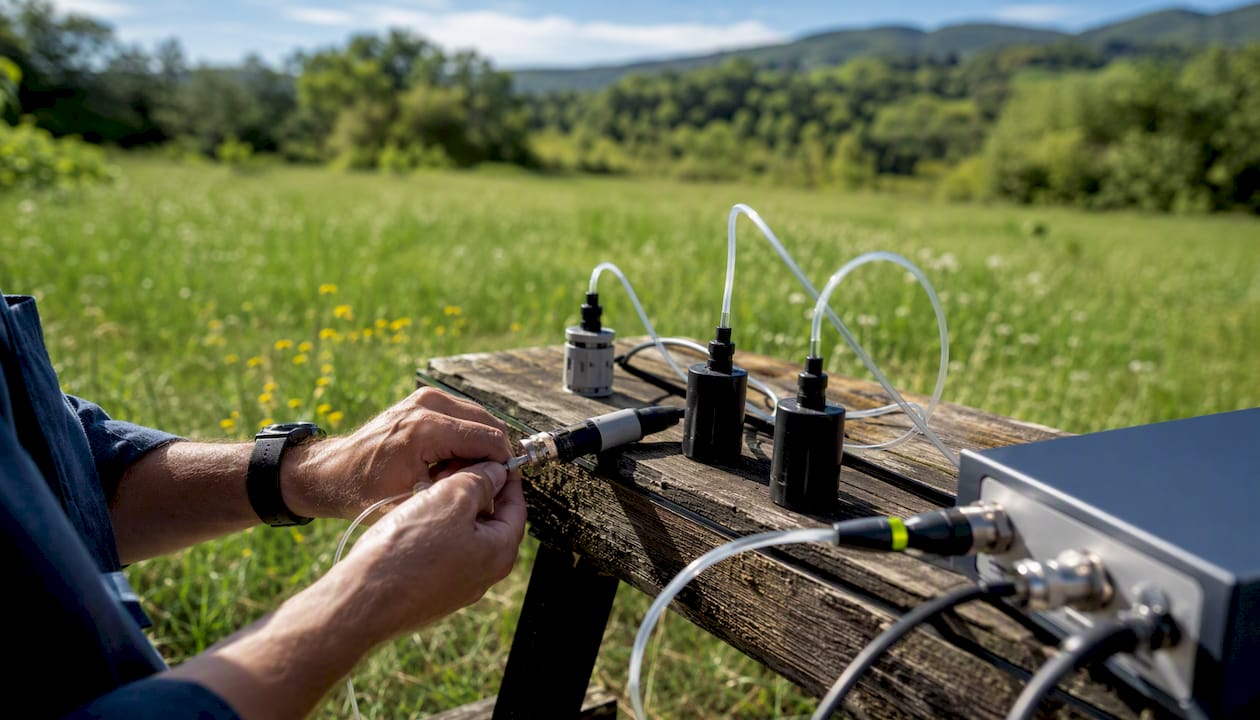
Suppliers delivering long contracts — particularly in construction, facilities management, and social housing retrofit — should expect buyers to include PPN 016 schedule terms more routinely. When that happens, you need ongoing data, not just a published PDF.
Three monitoring approaches suppliers currently use:
- Periodic manual reporting — quarterly or annual data submissions compiled from utility bills and travel records. Low cost, but data gaps are common and evidence arrives late.
- Meter-based verification — smart meter data pulled at regular intervals, giving monthly or half-hourly consumption figures. More reliable than manual methods and increasingly available through energy suppliers.
- Continuous IoT monitoring — real-time sensor data covering energy, temperature, and occupancy across a property or portfolio. Produces near-instant evidence, supports pre-emptive intervention, and generates the kind of defensible dataset that holds up under buyer scrutiny as Scope 3 expectations tighten.
The Technical Standard does not mandate external audit, but it does require defensible data and recognised methods. Stronger evidence is simply harder to challenge.
Pro Tip: Set up a data governance plan before the contract starts, not after the first buyer request arrives. Decide which data sources feed each emissions category, who is responsible for collection, and how long records are retained. A one-page evidence map shared with your sustainability lead and contract manager saves significant time when a buyer asks for contract-period reporting at short notice.
Why getting the CRP right is worth more than a tick-box exercise
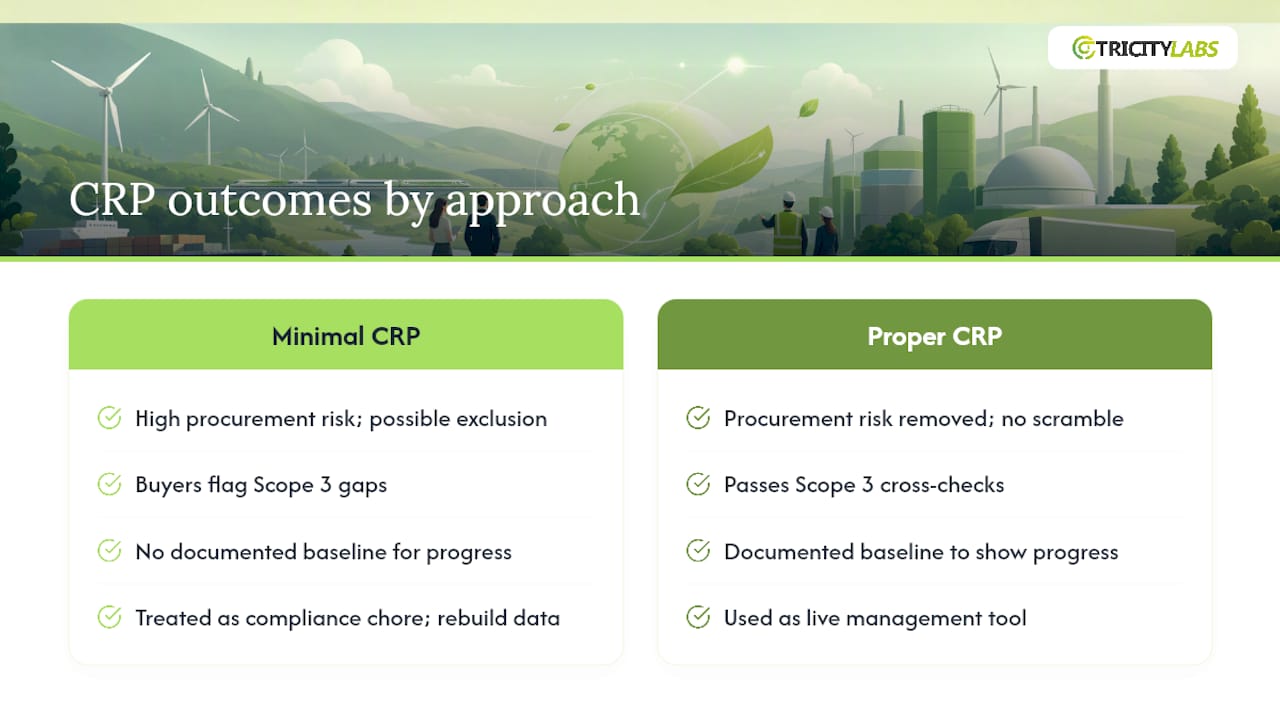
There is a tempting shortcut here: produce the minimum viable CRP, publish it, and move on. Many suppliers take it. The problem is that procurement teams are getting sharper. Buyers who once accepted a signed PDF with approximate figures are now cross-referencing Scope 3 categories against the template and flagging gaps before the SQ deadline closes.
A properly completed CRP does two things a minimal one cannot. First, it removes procurement risk entirely — no last-minute scramble when a bid drops, no exclusion on a technicality. Second, it gives you a documented baseline from which to demonstrate genuine progress, which matters when PPN 016 contract schedules become standard and buyers start comparing your reported emissions at contract end against the figures you submitted at selection.
The suppliers who treat the CRP as a live management tool rather than a bid document are the ones who will find contract-period reporting straightforward. The ones who treat it as a compliance chore will find themselves rebuilding their data from scratch every time a buyer asks a question.
Review the CRP template and the Technical Standard today. Check that your published plan is current, signed, and covers all five Scope 3 categories. If it is not, the fix takes hours, not weeks.
Continuous monitoring as one route to defensible contract evidence
For suppliers delivering retrofit programmes or long-term housing contracts, the gap between a published CRP and credible contract-period evidence is where things get difficult. Tricitylabs's Verity platform addresses that gap directly: continuous IoT monitoring of temperature, humidity, occupancy, and energy usage across residential portfolios, producing near real-time data that can feed directly into contract schedule reporting.
This is one approach among several the Technical Standard accepts. Buyers will consider any evidence that is defensible and methodologically consistent. What Verity offers is speed and granularity — rather than compiling quarterly manual reports, housing associations and retrofit contractors can draw on a continuous data record that is already structured for compliance purposes. If a buyer includes PPN 016 schedule terms and asks for emissions evidence mid-contract, the data is there.
Speak to the Tricitylabs team to see whether continuous monitoring fits your contract monitoring needs.
Sources
Use the official GOV.UK pages below. Download the template directly rather than reformatting its contents into another document — deviations are permitted only when all required fields are present, and the template structure makes compliance easiest to verify.
- Procurement Policy Note 06/21: Taking account of Carbon Reduction Plans in the procurement of major government contracts
- PPN 006: Technical standard for completion of Carbon Reduction Plans (HTML)
- Carbon Reduction Plan template
This article is general information, not a substitute for advice from a qualified lawyer. Consult a qualified legal professional about your own circumstances before acting on anything here.
Recommended
- Carbon Reduction Statement - Tenant Engagement - TRICITY LABS
- Environmental Policy Statement - Tenant Engagement - TRICITY LABS
- Tricity Labs | Independent Retrofit M&V for Housing Associations and Contractors
- News & Updates | Tricity Labs Platform developments, regulatory milestones, and insights from the intersection of energy, housing, and fintech — from the Tricity Labs team. - Tenant Engagement - TRICITY LABS