
Absolute humidity is a mass measurement: the actual weight of water vapour in a given volume of air, expressed in grams per cubic metre (g·m⁻³). Relative humidity is a proportion: the percentage of moisture the air is holding compared with the maximum it could hold at that exact temperature, always somewhere between 0% and 100%. The distinction that trips most people up is this: absolute humidity stays fixed unless water is physically added to or removed from the air, while relative humidity swings up and down all day as temperature changes, even when the actual water content hasn't moved a fraction.
That single fact explains most of the confusion around humidity readings.
- Absolute humidity = mass of water vapour per unit volume of air (g·m⁻³). It answers "how much water is actually in the air?"
- Relative humidity = percentage of saturation at the current temperature (0–100% RH). It answers "how full is the air's capacity right now?"
- The core difference: one is a fixed quantity, the other is a ratio that depends on temperature. Air can hold exactly the same amount of water at 8°C and 20°C, yet show wildly different RH percentages.
Key Takeaways
Relative humidity is a temperature-dependent percentage, while absolute humidity and dew point are fixed measures of actual moisture, and buildings need continuous data to tell the difference reliably.
| Point | Details |
|---|---|
| Core distinction | Absolute humidity measures mass (g·m⁻³); relative humidity measures a percentage of saturation that shifts with temperature. |
| Dew point is more stable | Dew point stays fixed as long as moisture content doesn't change, making it a better comfort and condensation indicator than RH alone. |
| Same moisture, different RH | Identical absolute humidity can read as 100% RH at 5°C and just 30% RH at 25°C. |
| Target indoor range | Aim for roughly 40 to 60% RH indoors, but always check cold surfaces against dew point, not just room-average RH. |
| Monitoring beats snapshots | Continuous temperature, humidity and occupancy tracking catches developing damp risks that a single annual inspection misses. |
Table of Contents
- Absolute humidity vs relative humidity: definitions and formulae
- Why does relative humidity change with temperature?
- How is humidity actually measured?
- What do these humidity measures mean for comfort and damp?
- Why do we still report relative humidity instead of absolute?
- How buildings actually track humidity over time
- Frequently asked questions
- Sources
Absolute humidity vs relative humidity: definitions and formulae
Absolute humidity, specific humidity and mixing ratio all describe moisture content, but they're not interchangeable, and mixing them up causes real errors in building diagnostics. Absolute humidity is mass of water vapour per unit volume of moist air, typically g·m⁻³. Specific humidity is mass of water vapour per unit mass of moist air (including the vapour itself), while mixing ratio is mass of water vapour per unit mass of dry air only. The differences are small numerically but matter in precise engineering work, because absolute humidity depends on air density and therefore on pressure, whereas specific humidity and mixing ratio do not.
Relative humidity is where most people actually start, since it's what every weather app displays. The formula is straightforward:
RH = (e / es) × 100%
Here, e is the actual vapour pressure of the water in the air, and es is the saturation vapour pressure, the maximum vapour pressure possible at that temperature. Because saturation vapour pressure rises steeply as temperature increases, the same actual vapour pressure produces a lower RH reading in warm air than in cold air. This is the entire mechanism behind why a "muggy" summer morning can register 95% RH while a bone dry winter afternoon reads 40%, despite the winter air often containing barely a fifth of the moisture.
- Meteorologists lean on relative humidity and dew point because both translate directly into visible phenomena: fog, dew, frost.
- HVAC and building engineers lean on absolute measures (humidity ratio, dew point) because their calculations need a number that doesn't shift every time the thermostat clicks.
- Process control industries, from compressed air systems to pharmaceutical manufacturing, often abandon RH altogether in favour of dew point or absolute humidity, because at very low moisture levels RH loses meaning.
Why does relative humidity change with temperature?
Warm air can physically hold more water vapour than cold air before reaching saturation. That's the whole story, but it's worth walking through with real numbers, because the effect is bigger than most people expect.
Picture a parcel of air holding a constant 7 g·m⁻³ of water vapour, a genuinely fixed absolute humidity, moved through a heating cycle over a single day.
- At 5°C, the saturation point is roughly 6.8 g·m⁻³. With 7 g·m⁻³ actually present, that air is essentially saturated, sitting at around 100% RH. You'd expect mist or dew.
- At 15°C, saturation capacity climbs to roughly 12.8 g·m⁻³. The same 7 g·m⁻³ of water vapour now represents only about 55% RH.
- At 25°C, saturation capacity reaches roughly 23 g·m⁻³. That identical 7 g·m⁻³ of moisture now reads as just 30% RH.
Not a single molecule of water was added or removed across that whole cycle. The RH reading fell from 100% to 30% purely because the air's capacity expanded as it warmed. This is exactly why RH commonly peaks in the early morning and drops through the warmest part of the day, even on days when no rain falls and no moisture is lost.
Dew point cuts straight through that noise. It's the temperature air would need to cool to before it reaches saturation and starts condensing. In the example above, the dew point stays fixed at roughly 5°C throughout the entire day, because the actual moisture content never changed. Dew point tracks moisture mass directly, which is why meteorologists increasingly favour it as the number that tells you how the air will actually feel.
Pro Tip: If you want to sketch this relationship, plot temperature on the horizontal axis and saturation vapour pressure on the vertical axis. Draw the curved capacity line rising steeply, then mark two points at the same horizontal moisture level, one where the curve is high above it, one where it's barely above it. The vertical gap between your fixed moisture line and the capacity curve is your RH.
How is humidity actually measured?
Three main instrument families cover almost every real world humidity reading, and each has a different blind spot worth knowing before you trust a number.
- Capacitive and resistive hygrometers are the small sensors inside most smart thermostats, weather stations and building monitoring kit. They measure RH directly by tracking how a polymer film's electrical properties change as it absorbs or releases moisture.
- Psychrometers use two thermometers, one wrapped in a wet wick, and calculate RH from the temperature difference caused by evaporative cooling. Reliable, but they need decent airflow across the wet bulb to work accurately.
- Chilled mirror dew-point sensors cool a small mirror until condensation just begins to form, reading the dew point directly rather than inferring it. These are the gold standard for precision work because they measure an absolute property rather than a temperature-dependent ratio.
Deriving absolute humidity from a sensor reading requires the temperature and, ideally, atmospheric pressure, since absolute humidity depends on air density and therefore on pressure. Most consumer sensors skip that pressure correction entirely, which is fine at sea level in stable conditions but introduces small errors at altitude or during rapid weather changes.
Accuracy problems in the field rarely come from the sensor chip itself. They come from placement: a hygrometer mounted in direct sunlight, next to a radiator, or in a stagnant corner with no airflow will report a reading that has almost nothing to do with the room's actual air. Calibration drifts over months, particularly with cheap capacitive sensors, so any monitoring set-up worth trusting needs a maintenance schedule and periodic checks against a reference instrument. For building monitoring specifically, sampling every 10 to 30 minutes tends to catch meaningful trends, condensation events, ventilation gaps, heating cycles, without drowning the data in noise from momentary fluctuations.
What do these humidity measures mean for comfort and damp?
Relative humidity alone is a poor predictor of how muggy a room actually feels, and this catches a lot of people out. Two rooms can both read 60% RH, one at 12°C and one at 24°C, yet contain wildly different amounts of actual moisture and feel completely different against your skin. Dew point ties directly to the moisture mass that affects how well sweat evaporates from skin, which is why it's a far better single number for comfort than RH on its own.
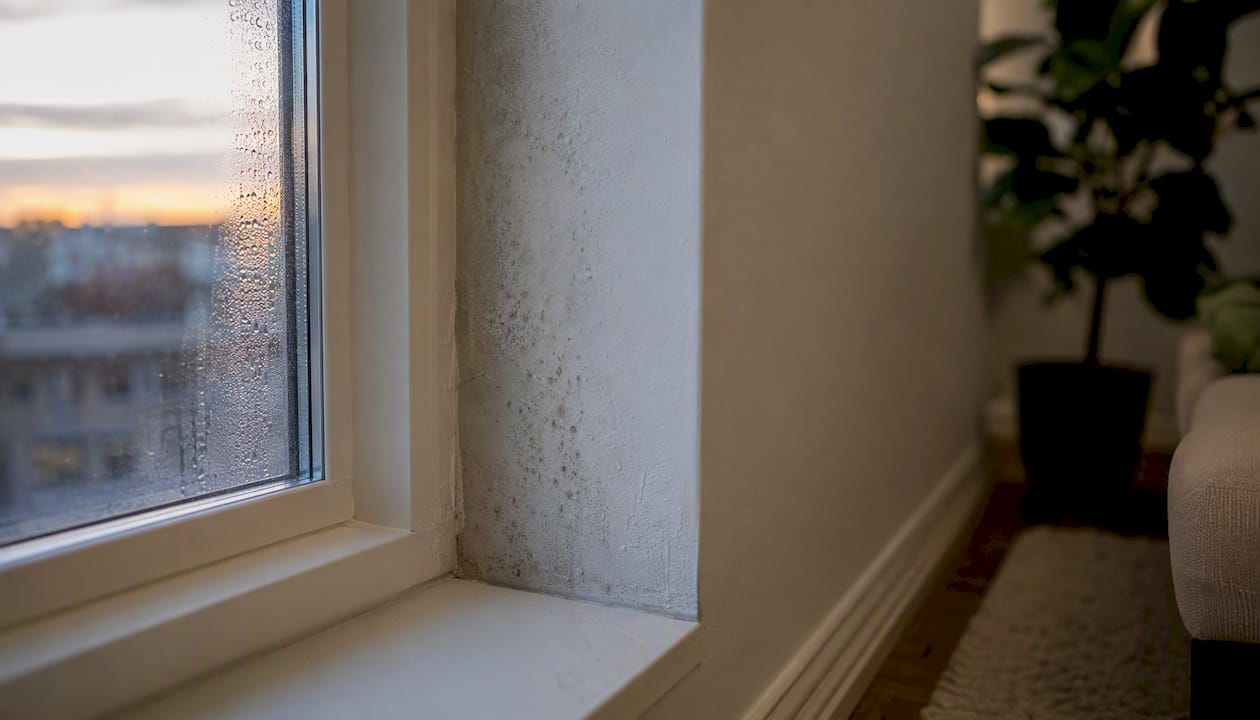
Condensation risk works the opposite way round from comfort. It's driven by local temperature drops against a fixed moisture load. A cold external wall, an uninsulated window reveal, or a corner behind furniture with poor air circulation can sit several degrees cooler than the rest of a room. If that surface temperature falls below the room's dew point, moisture condenses there directly, regardless of what the RH reads on a sensor in the middle of the room. That's the mechanism behind almost every mould outbreak in a home: not "the room is humid", but "one surface is cold enough to hit dew point while the rest of the room isn't."
- Aim for indoor RH somewhere between 40% and 60% for a reasonable comfort and mould-prevention balance, adjusted for outdoor temperature.
- Watch for cold surfaces (external walls, window reveals, thermal bridges) rather than only the room-average RH reading.
- Improve background ventilation before reaching for a dehumidifier. Trickle vents, extractor fans and reduced drying-clothes-indoors habits solve more damp problems than people expect.
- Use absolute humidity or humidity ratio, not RH, when sizing a dehumidifier or calculating moisture loads. RH won't tell you how many litres of water you actually need to remove.
- Track dew point alongside RH in any room with a known condensation history. It's the number that tells you whether a cold snap is about to trigger visible condensation.
NPL's research notes that RH becomes genuinely unreliable at the extremes: in very dry environments like compressed air systems, RH can fall below 1% and provide almost no useful resolution, which is exactly why process engineers switch to dew point or absolute measures for anything requiring precision.
Why do we still report relative humidity instead of absolute?
Because it's genuinely easier to communicate. Meteorology has reported RH for well over a century for exactly these reasons, and the habit is now deeply embedded in forecasting, broadcasting and public expectation.
The trade-off is real, though. Because RH depends so heavily on temperature, it can mislead anyone trying to diagnose an actual moisture problem.
So when should you reach for RH, and when should you reach for dew point or an absolute measure? RH works well for quick comfort checks, weather forecasts and situations where you just need a snapshot at a known temperature. Dew point and absolute humidity work better whenever you're comparing conditions across different temperatures, sizing equipment, or diagnosing condensation and mould, because they don't move the goalposts every time the temperature shifts.
How buildings actually track humidity over time
Comfort theory only gets you so far. The real test of any humidity measurement is whether it can catch a developing damp problem before it becomes a tenant complaint, a repair bill, or a health issue, and that's a monitoring question, not a formula question.
Effective sensor strategy in housing stock follows a few consistent principles:
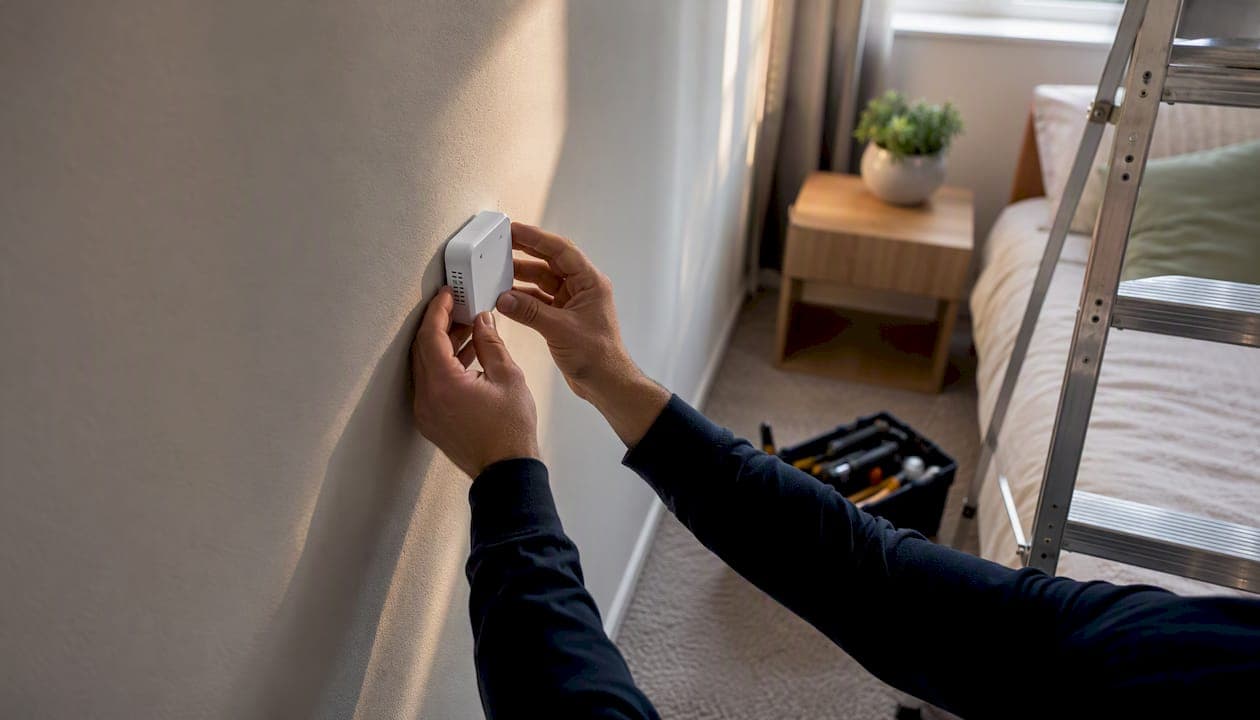
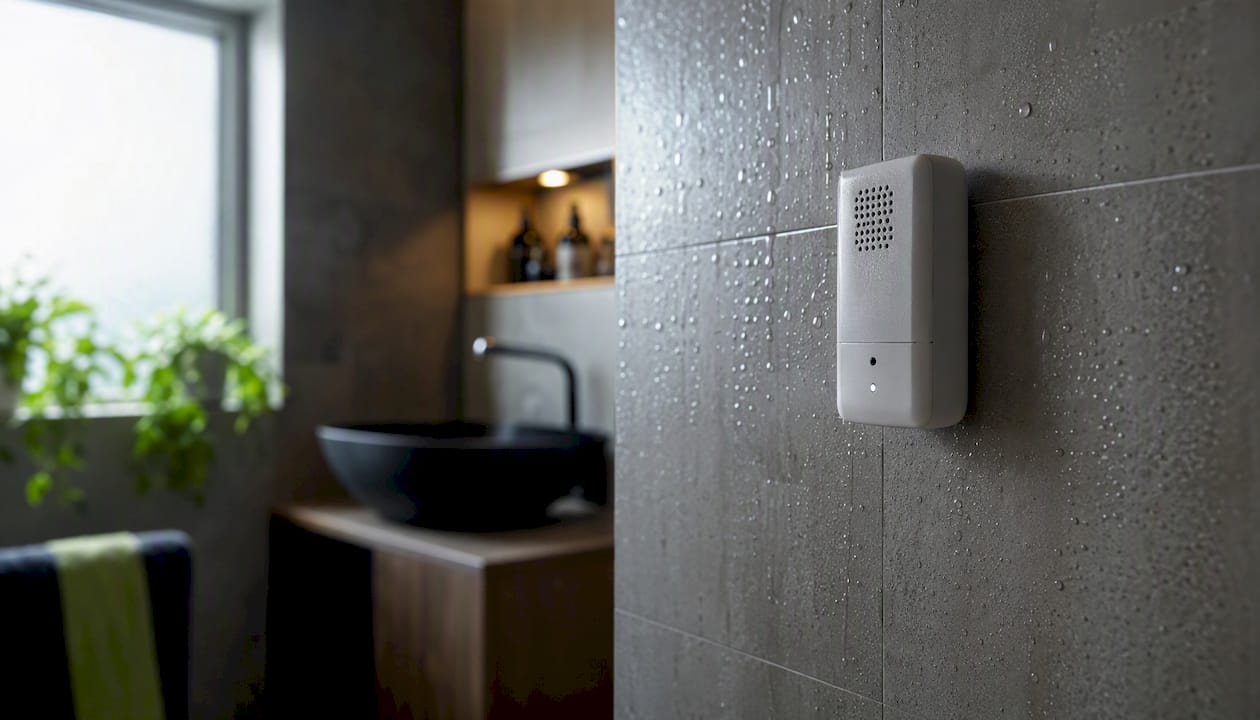
- Place sensors in rooms with known risk factors first: bathrooms, kitchens, north-facing bedrooms and any room with a documented condensation or mould history.
- Measure temperature, relative humidity and, where possible, derive dew point, alongside occupancy data, since an empty, unheated property behaves completely differently from an occupied one.
- Sample frequently enough to catch trends and events (every 10 to 30 minutes is typical) without generating unmanageable volumes of noise.
- Track data over weeks and seasons rather than relying on a single spot-check, since a one-off reading during a warm afternoon can miss a condensation risk that only appears overnight.
The value of continuous data over a single annual inspection is straightforward: an inspection captures one moment, while a damp problem develops over weeks of temperature swings, heating patterns and ventilation habits that a snapshot simply cannot see. This is the gap that continuous, independent monitoring exists to close. Tricitylabs' Verity platform tracks temperature, humidity and occupancy in real time across housing association portfolios, flagging cold and damp risk before it escalates into a formal complaint, and providing the kind of longitudinal evidence that a once-a-year inspection structurally cannot produce.
That independence matters for a specific reason: when the same organisation delivers retrofit work and also verifies its own results, the evidence is harder to trust. Keeping monitoring separate from delivery means the data housing associations use for maintenance prioritisation and regulatory compliance reflects what's actually happening in a property, not what a delivery contract needs it to show. That's also the standard that matters for verifying retrofit outcomes properly, comparing genuine pre and post intervention performance rather than assuming a retrofit worked because it was installed.
What actually matters when someone reports a damp complaint
If I had to pick one number to check first when a tenant reports a damp or "stuffy" room, it wouldn't be relative humidity. It would be dew point, cross-referenced against the coldest surface temperature in that room. RH on its own tells you almost nothing about whether condensation is imminent, because it's relative to whatever the air temperature happens to be at that exact moment. Dew point tells you the actual moisture load, and once you know that, checking it against surface temperatures at thermal bridges (window reveals, external corners, behind wardrobes pushed against outside walls) tells you whether condensation is about to happen or already has.
My other practical recommendation: don't trust a single reading, however precise the instrument. A capacitive hygrometer glued to a wall for five minutes tells you about that five minutes. A damp problem is a pattern across weeks, heating cycles and occupancy changes, and only continuous monitoring reveals that pattern reliably. Anyone diagnosing a recurring damp complaint from a single visit with a handheld meter is working with roughly the same amount of information as a doctor diagnosing a chronic illness from one blood pressure reading.
Frequently asked questions
Is relative humidity vs absolute humidity the same as RH vs dew point? Not quite, though they're closely related. Dew point is itself an absolute measure, a temperature that stays fixed as long as moisture content doesn't change, so comparing RH with dew point is really a specific version of the relative versus absolute comparison.
What is a normal absolute humidity value indoors? It varies by season and heating pattern, but many temperate indoor environments sit somewhere between 5 and 12 g·m⁻³. There's no single universal "normal" figure, since it depends on outdoor conditions, ventilation and occupancy.
Why does my hygrometer show different RH readings in different rooms of the same house? Because RH depends on local temperature as much as moisture content. A cooler room can show much higher RH than a warmer room next door even when both contain similar absolute moisture, simply because the cooler room's air has less capacity.
No, not under normal atmospheric conditions.
Does air pressure affect relative humidity readings? Air pressure affects absolute humidity more directly, since it depends on air density. RH is affected indirectly through its influence on saturation vapour pressure, though the effect is generally smaller than the impact of temperature.
How does humidity measurement differ from moisture content measurement in materials? Humidity measurement describes water vapour in air, while moisture content in a material (timber, plaster, insulation) measures water absorbed into the material itself. The two interact, since high ambient humidity can drive moisture into materials over time, but they're measured with different instruments entirely.
Sources
For readers who want to check the underlying science or dig into sensor guidance before starting building work, these sources cover the primary technical ground:
- Understanding humidity — Met Office
- Humidity — Wikipedia
- Understanding humidity, part 1: Fundamental concepts every engineer should know — Vaisala
- What Is Humidity? | NESDIS (NOAA)
Anyone doing hands-on building work, sizing a dehumidifier, chasing a persistent condensation problem, or specifying retrofit measures, gets more useful diagnostic value from dew point and sensor placement guidance than from RH percentages alone.
Recommended
- Page Template - Tenant Engagement - TRICITY LABS
- Continuous Property Health Audit | Housing Associations | Tricity Labs - Tenant Engagement - TRICITY LABS
- Tricity Labs | Independent Retrofit M&V for Housing Associations and Contractors
- Free Tenant Energy Rewards | Tricity Labs - Tenant Engagement - TRICITY LABS