
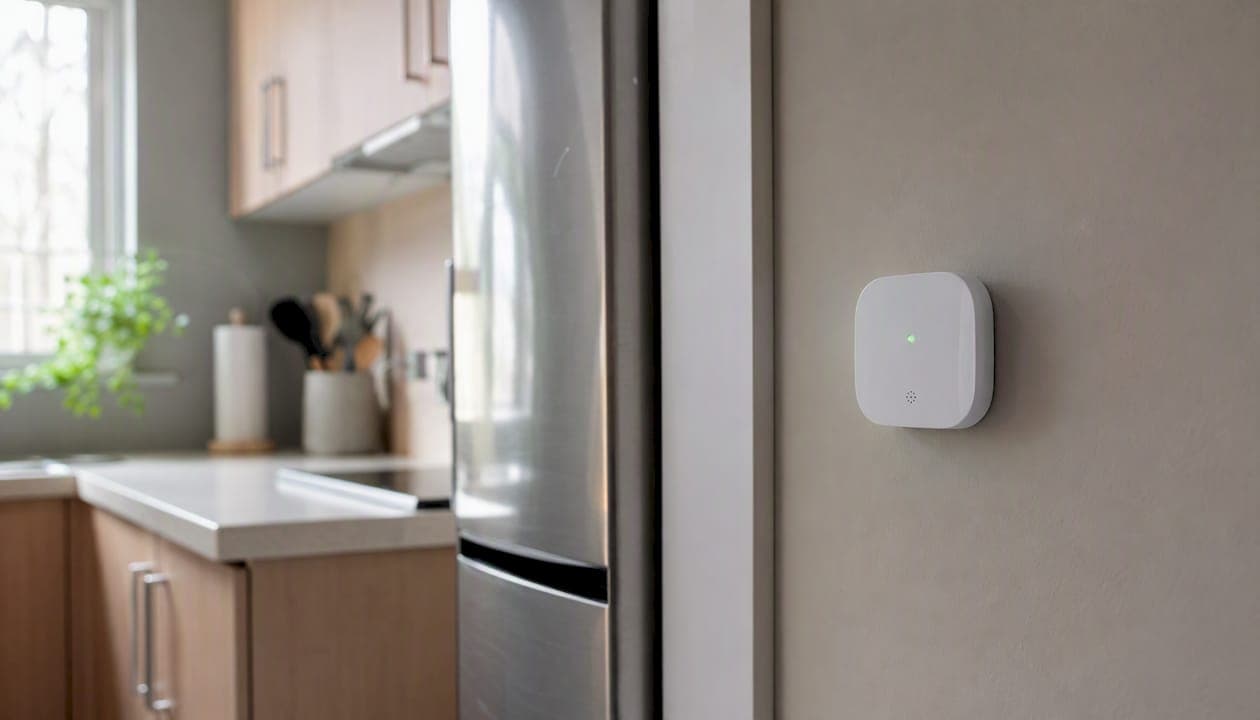
For organisations managing residential portfolios or regulated storage, the right approach to temperature and humidity monitoring is a continuous IoT platform with calibrated sensors, encrypted data pipelines, and portfolio-level reporting. A single annual inspection tells you what conditions were on one day; a continuous system tells you what they are every fifteen minutes, every day, across every property.
Three reasons this matters in practice:
- Real-time alerts catch cold or damp conditions before they become tenant complaints, enforcement notices, or insurance claims.
- Calibrated sensors with exportable audit trails give you defensible evidence for regulatory submissions, retrofit verification, and funding applications.
- Portfolio benchmarking lets you rank properties by risk, prioritise maintenance spend, and demonstrate improvement over time rather than guessing at it.
The practical next step is to pilot a small sample of properties, generally recommended as a modest group of units, to validate sensor placement, data quality, and alert thresholds before committing to a full rollout. Request a demo from your chosen vendor before signing any licence agreement.
Pro Tip: Ask every vendor for a sample data export in your preferred format (CSV or API) before the pilot begins. If they cannot produce one on request, data portability will be a problem at contract renewal.
Key takeaways
Continuous, calibrated IoT monitoring with portfolio-level reporting is the only approach that gives UK housing associations the real-time evidence they need for proactive property management and regulatory compliance.
| Point | Details |
|---|---|
| Choose continuous IoT sensors | Fixed sensors with 5–15 minute sampling intervals provide the unbroken data series that annual inspections cannot. |
| Require calibration certificates | Demand UKAS or NIST-traceable certificates and a stated drift specification from every supplier. |
| Model total cost of ownership | Hardware price is the smallest cost; subscription, calibration, and installation labour dominate the five-year figure. |
| Pilot before full rollout | Run a 12-week pilot across 20–50 properties with a 95% data completeness target before committing to scale. |
| Tricitylabs Verity | Provides continuous, independent portfolio monitoring for housing associations, with GDPR-compliant data handling and compliance-ready reporting. |
Table of Contents
- What types of temperature and humidity monitoring devices should you use?
- Which specifications should you require from devices and suppliers?
- How do connectivity and data management work in practice?
- How should you plan sensor deployment and sampling strategy?
- What are the real benefits of continuous environmental monitoring for organisations?
- How should you budget and procure monitoring at scale?
- Why independent, continuous monitoring matters: the Tricitylabs approach
- Your supplier evaluation checklist
- Why the annual inspection model is already obsolete
- Tricitylabs Verity: continuous monitoring built for housing associations
- Sources
What types of temperature and humidity monitoring devices should you use?
The market divides into four main categories, and choosing the wrong one for your use case costs money twice: once when you buy it, and again when it fails to deliver the data you actually need.
Battery-powered data loggers record readings at set intervals and store them internally until you download the data manually or via USB. UK suppliers list these for long-period environmental monitoring and storage applications where mains power is unavailable and connectivity is limited. They are reliable and low-cost, but the data is only as current as your last download.
Fixed IoT sensors transmit readings continuously over Wi-Fi, cellular, or low-power wide-area networks such as LoRaWAN. This is the category that suits portfolio-scale monitoring: data arrives in near real time, alerts fire automatically, and you never need to physically retrieve a device to see what happened last Tuesday night.
Handheld meters are spot-check instruments. They are useful for surveyor visits, commissioning checks, and verifying that a fixed sensor is reading correctly, but they produce no continuous record and cannot trigger alerts.
Probe-based systems are designed for controlled environments such as cold rooms, server cabinets, and archive vaults, where the sensor must be physically inserted into the monitored space. They often connect to a fixed logger or IoT gateway.
| Environment | Recommended category | Reason |
|---|---|---|
| Social housing stock | Fixed IoT sensors | Continuous data, remote alerting, no manual retrieval |
| Archives and museums | Data loggers or fixed IoT | Long-period records; IoT preferred where connectivity exists |
| Cold chain and storage | Probe-based IoT systems | Precise point measurement inside refrigerated units |
| Plant rooms | Fixed IoT sensors | Continuous oversight; integration with building management systems |
| Retrofit verification | Fixed IoT sensors | Pre/post intervention comparison requires unbroken data series |
| Surveyor spot checks | Handheld meters | Rapid on-site verification; no ongoing monitoring needed |
Which specifications should you require from devices and suppliers?
Procurement teams often focus on unit price and overlook the specifications that determine whether the data is actually usable. Here is what to put in your tender documents.
Core sensor accuracy and calibration
For compliance-critical applications, require a NIST-traceable or UKAS-traceable calibration certificate supplied with each unit. Calibration drift matters over time: ask for the manufacturer's stated drift specification per year and factor that into your calibration cadence.
Anything coarser makes it harder to detect gradual deterioration in conditions.
Operational specifications
- Sampling interval: configurable, with at least 5-minute intervals available for continuous monitoring applications.
- Battery life: minimum 12 months on a single charge or set of batteries for wireless units; mains-powered options for plant rooms and archives.
- Ingress protection: IP54 minimum for any sensor installed in a bathroom, kitchen, or plant room.
- Mounting: surface-mount bracket or DIN rail options; confirm the sensor can be installed without specialist tools.
- Probe compatibility: check whether external probes are supported if you need to monitor inside a duct, fridge, or wall cavity.
Platform and service requirements
- Configurable alarm thresholds per sensor or zone, with multi-channel alerting (email, SMS, push notification).
- Multi-user access with role-based permissions so surveyors, asset managers, and compliance officers see only what they need.
- Data export in CSV and via REST API, with a stated retention period of at least five years.
- A written SLA covering uptime, alert delivery latency, and support response times.
- On-site calibration or a return-to-base calibration service with a defined turnaround.
Pro Tip: Require vendors to state their sensor drift specification in writing. That gap is invisible unless you ask.
How do connectivity and data management work in practice?
Connectivity is where many deployments quietly fail. A sensor that cannot reliably transmit its readings is just an expensive data logger with a dead battery.
Connectivity options
- Wi-Fi (2.4GHz): widely available in residential properties, but signal quality varies by building construction. Concrete and steel frames attenuate signal significantly. Requires the tenant's or landlord's router to remain online.
- Cellular (4G/LTE or NB-IoT): independent of the property's broadband; the sensor carries its own SIM. Higher running cost but far more reliable for properties where Wi-Fi is absent or unreliable.
- LoRaWAN: long-range, low-power protocol suited to dense urban deployments where a single gateway can cover dozens of properties. Requires gateway infrastructure investment upfront.
- Zigbee/BLE gateways: hub-based sensors can extend battery life and reliability, but they add gateway management and range planning overheads that matter at scale. Worth considering for contained sites such as a single block of flats, less practical across a dispersed housing stock.
Testo's UK guidance on building comfort measurement recommends matching the connectivity choice to the building type and monitoring duration rather than defaulting to whichever protocol is cheapest per unit.
Data handling expectations
Data encrypted in transit (TLS 1.2 or higher) and at rest, with a documented retention policy and a self-service export route, is the minimum standard for any monitoring system used in regulated or compliance-sensitive applications.
Verify that your vendor can confirm encryption standards in writing. Ask specifically about where data is stored (UK or EU data centres are preferable for GDPR purposes), who owns the data, and what happens to historical records if you terminate the contract.
Alerting and integrations
- Push notifications, email, and SMS alerts with configurable delay and escalation rules.
- Webhooks and REST APIs for integration with CAFM systems, housing management platforms, or internal dashboards.
- Check whether the platform supports two-way integration: can a triggered alert automatically create a maintenance ticket in your existing system?
Some Wi-Fi devices, such as those from TempStick, advertise unlimited historical logging and instant alerts without a recurring subscription. That model suits smaller deployments, but buyers should weigh the absence of a managed SLA and long-term vendor support against the lower ongoing cost.
How should you plan sensor deployment and sampling strategy?
Getting the hardware right is only half the job. A poorly placed sensor in a well-heated corridor will never detect the cold bedroom two metres away.
Placement rules
- Mount sensors at 1.0–1.5 metres above floor level, away from external walls, windows, and heat sources such as radiators, boilers, and cooking appliances.
- In residential properties, prioritise the bedroom and living room as primary monitoring points; bathrooms are secondary unless mould risk is the specific concern.
- Keep sensors at least 0.5 metres from air vents, extractor fans, and doorways where transient air movement distorts readings.
- In storage and archive environments, place sensors at multiple heights if the space is tall, since temperature stratification can be significant.
- For retrofit verification, install sensors before any works begin and leave them in place through the post-intervention period to capture a clean before/after comparison.
Sampling strategy
For continuous monitoring of residential properties, a 5–15 minute sampling interval gives sufficient resolution to detect overnight temperature drops and humidity spikes without generating unmanageable data volumes. Specialised cases such as cold chain or transient process monitoring may need 30-second to 1-minute intervals, but that granularity is rarely necessary for housing stock.
Pro Tip: Run a two-week baseline period before setting alert thresholds. Properties vary considerably in their normal temperature and humidity profiles, and thresholds set without a baseline produce excessive false alerts that teams quickly learn to ignore.
Maintenance planning
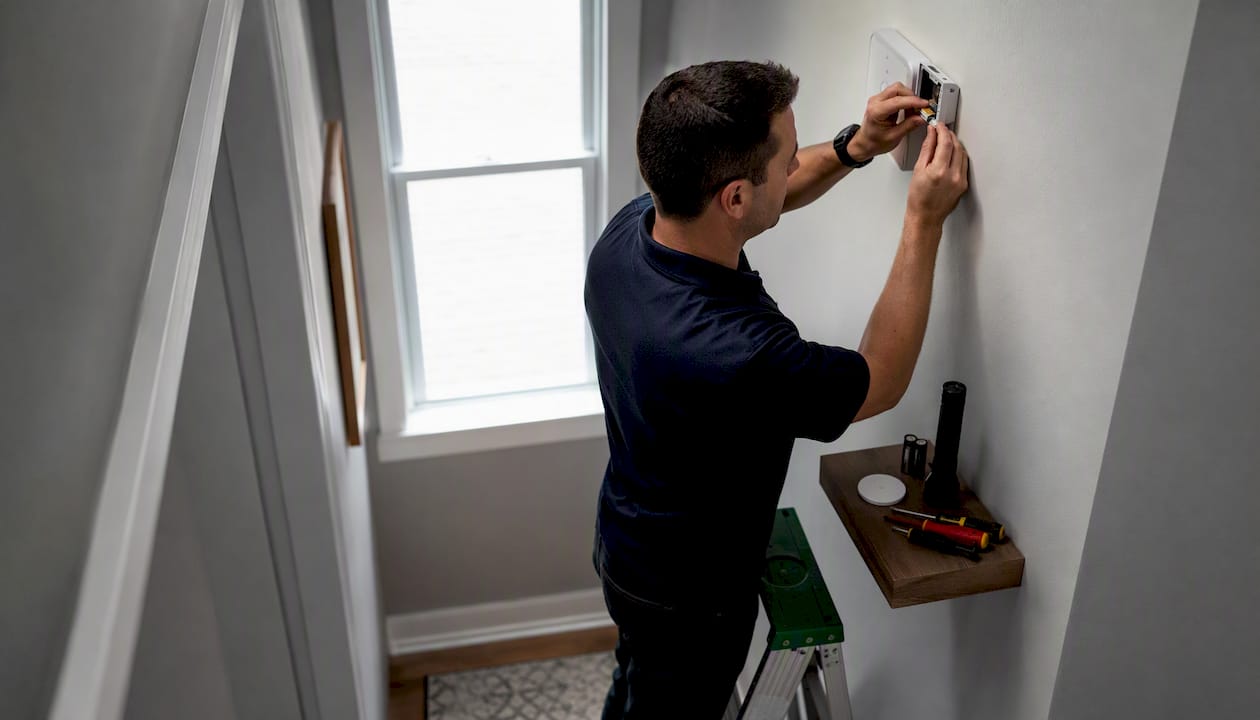
Calibrate sensors annually as a minimum, or every six months for compliance-critical applications. Schedule battery replacement at the same visit to reduce site visits. Keep a firmware update log: outdated firmware is a common source of connectivity failures that are misdiagnosed as hardware faults.
What are the real benefits of continuous environmental monitoring for organisations?
The business case for continuous monitoring is strongest when you can attach a cost to the problem it prevents.
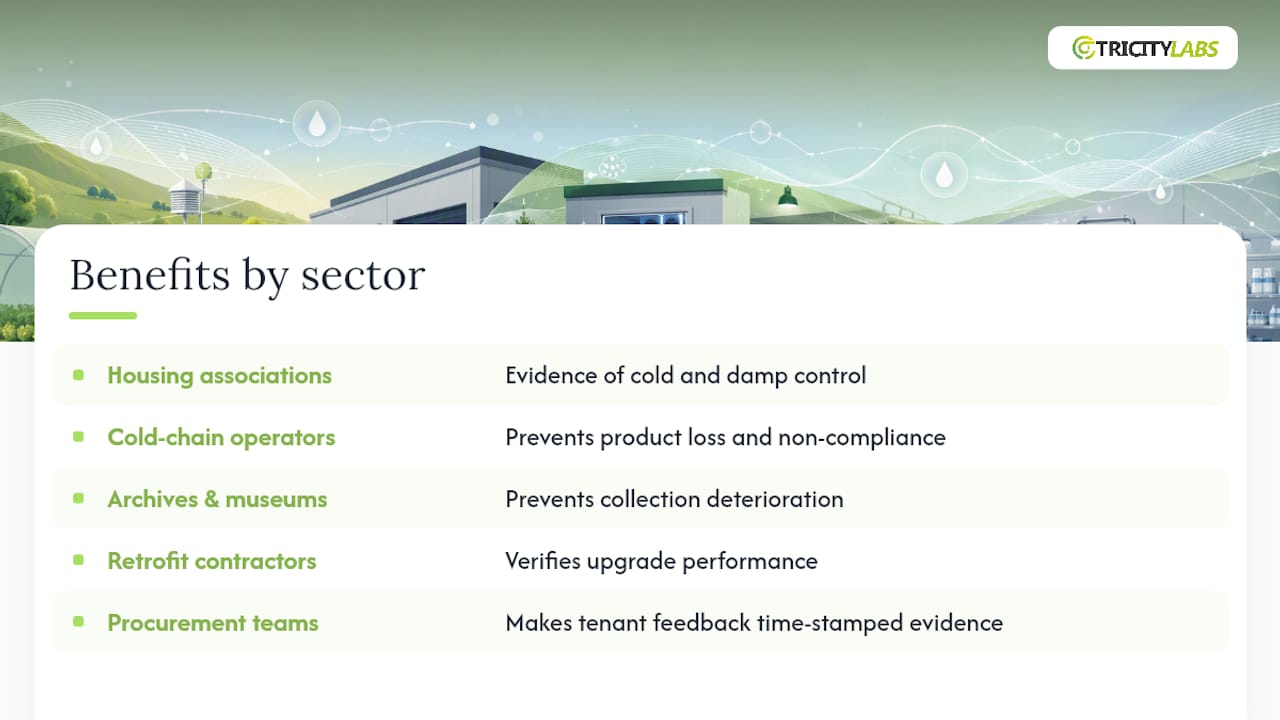
Housing associations face increasing regulatory pressure under the Decent Homes Standard and the Social Housing (Regulation) Act 2023. Continuous monitoring of indoor temperature and humidity provides the evidence base to demonstrate proactive management of cold and damp conditions, which are among the most common grounds for tenant complaints and enforcement action.
Cold chain and storage operators use continuous monitoring to protect stock value and meet food safety obligations under UK Food Standards Agency guidance. An undetected overnight temperature excursion in a storage unit can result in product loss, regulatory non-compliance, and reputational damage.
Archives and museums rely on stable humidity control to prevent deterioration of collections.
Retrofit contractors use pre/post monitoring data to verify that insulation, ventilation, or heating upgrades have delivered the expected improvement in internal conditions. Without continuous data, the claimed savings are unverifiable.
Key benefit for procurement teams: continuous monitoring converts anecdotal tenant feedback into quantified, time-stamped evidence. That evidence supports compliance submissions, funding applications, and maintenance prioritisation in ways that a surveyor's annual report simply cannot.
The Verity platform from Tricitylabs is built specifically around this use case: detecting cold and damp patterns across a housing portfolio before they escalate, and producing the portfolio-level benchmarking reports that housing associations need for regulatory submissions.
How should you budget and procure monitoring at scale?
Cost modelling for a monitoring deployment has more moving parts than most procurement teams expect. The hardware unit price is usually the smallest line item.
Cost components to model
- Hardware: sensor unit cost varies by connectivity type. Wi-Fi sensors typically cost less per unit than cellular equivalents, but cellular avoids gateway infrastructure costs.
- Gateways and network: LoRaWAN deployments require gateway hardware and network management. Cellular deployments require SIM data plans per sensor.
- Installation labour: factor in travel time, access coordination with tenants, and the time to configure and commission each sensor on-site.
- Platform subscription: SaaS licences are typically priced per property or per sensor per year. Confirm what is included: data storage, alerting, API access, and support.
- Calibration: annual calibration costs either a return-to-base fee per sensor or an on-site visit charge. Model this across your full sensor estate.
- Support and SLA: premium support tiers cost more but reduce the risk of undetected sensor failures going unresolved for weeks.
Procurement approach
- Pilot first: run a 20–50 property pilot for 3–6 months before committing to a full rollout. Define success metrics upfront: alert accuracy, data completeness, and staff time saved.
- Total cost of ownership (TCO): model hardware, subscription, installation, calibration, and support over a five-year horizon. A cheaper sensor with a higher calibration cost and no API access may cost more over five years than a premium unit with full integration.
- Contract terms to negotiate: data ownership clause (you own the data, not the vendor), exit export provision (full historical data export on termination), SLA with financial remedy, and a price-lock or cap on subscription increases.
Procurement checklist for tender documents
- State required accuracy, range, and calibration certificate standard (UKAS or NIST traceable).
- Specify connectivity protocol and confirm coverage requirements for your property types.
- Require a sample data export in CSV and API format as part of the tender response.
- Ask for evidence of GDPR compliance: data residency, encryption standards, and a Data Processing Agreement.
- Request references from at least two UK housing associations or equivalent regulated organisations.
- Define the pilot scope, duration, and success criteria in the contract before signing.
Why independent, continuous monitoring matters: the Tricitylabs approach
Most housing associations still rely on reactive monitoring: a tenant complains, a surveyor visits, a report is written. By the time that cycle completes, the conditions that caused the complaint may have persisted for months.
Tricitylabs' Verity platform takes a different approach. Sensors installed across a property portfolio transmit temperature, humidity, and occupancy data continuously. The platform analyses that data at portfolio level, flagging properties where conditions fall below acceptable thresholds before any complaint is raised. Housing associations can then prioritise maintenance visits based on actual measured conditions rather than estimated risk.
The independence of the platform matters as much as its technical capability. Because Tricitylabs does not deliver retrofit works, the monitoring data it produces is not subject to the conflict of interest that arises when the same organisation both installs insulation and reports on whether it worked. That independence makes the evidence more credible to regulators, funders, and tenants.
Continuous, independent monitoring converts a housing association's property portfolio from a collection of assumptions into a set of measured, time-stamped facts. That shift from assumption to evidence is what makes proactive intervention possible.
For retrofit verification specifically, Verity captures pre-intervention baselines and post-intervention performance in the same data environment, producing a clean comparison that satisfies Measurement and Verification (M&V) requirements for funding bodies and compliance submissions.
| Verity capability | Organisational benefit |
|---|---|
| Continuous temperature and humidity sensing | Detects cold and damp conditions before tenant complaints |
| Portfolio benchmarking | Ranks properties by risk; prioritises maintenance spend |
| Tenant-facing dashboards | Improves tenant engagement and transparency |
| Pre/post retrofit comparison | Provides defensible M&V evidence for funding submissions |
| GDPR-compliant data handling | Supports compliance with UK data protection obligations |
Your supplier evaluation checklist
Use this checklist during demos and when scoring tender responses.
Technical and data requirements
- Sensor accuracy: ±2%RH humidity, ±0.5°C temperature or better.
- Calibration certificate: UKAS or NIST traceable, supplied with each unit.
- Sampling interval: configurable to 5 minutes or less for continuous monitoring.
- Data encryption: TLS 1.2+ in transit; AES-256 or equivalent at rest.
- Data export: CSV and REST API, with at least five years' retention.
- GDPR compliance: UK or EU data residency; Data Processing Agreement available.
Supplier questions to ask during demos
- What is your stated sensor drift per year, and how do you recommend managing it?
- Can you demonstrate a live data export via API during this session?
- What is your alert delivery SLA, and what happens if an alert is delayed?
- How do you handle sensor failures: replacement, credit, or on-site swap?
- Who owns the historical data if we terminate the contract, and how is it exported?
- Can you provide references from UK housing associations currently using the platform?
- What does your onboarding process look like for a 200-property pilot?
Pilot design guidance
A well-designed pilot answers three questions before you commit to a full rollout: does the sensor reliably transmit data from your property types? Do the alerts fire at the right thresholds without excessive false positives? And does the platform produce reports your compliance team can actually use?
Run the pilot for at least 12 weeks across a mix of property archetypes (solid wall, cavity wall, flats, houses).
Why the annual inspection model is already obsolete
The conventional wisdom in housing management has long been that an annual stock condition survey, supplemented by reactive maintenance, is a reasonable way to manage property health. It is not, and the evidence for that is now too clear to ignore.
A surveyor visiting a property in August cannot tell you what the bedroom temperature was in January. A tenant complaint logged in March cannot tell you whether the damp patch on the wall appeared last week or last winter. Annual snapshots produce annual reports that describe conditions as they were on one day, not as they are across a heating season.
The regulatory direction is moving firmly toward continuous, evidenced monitoring. The Social Housing (Regulation) Act 2023 and the ongoing development of the Home Energy Model both point toward a future where housing providers are expected to demonstrate, not merely assert, that their properties meet acceptable standards.
Organisations that invest in continuous monitoring now are not just solving a current compliance problem. They are building the data infrastructure that will be required to operate in the regulated housing environment of the next decade. The organisations that wait for enforcement to force the issue will find themselves retrofitting both their buildings and their data systems at the same time, under pressure, at higher cost.
Tricitylabs Verity: continuous monitoring built for housing associations
Housing associations managing large portfolios need more than a sensor and a dashboard. They need a platform that flags problems before tenants do, produces evidence that satisfies regulators, and gives asset managers a clear view of where to spend next.
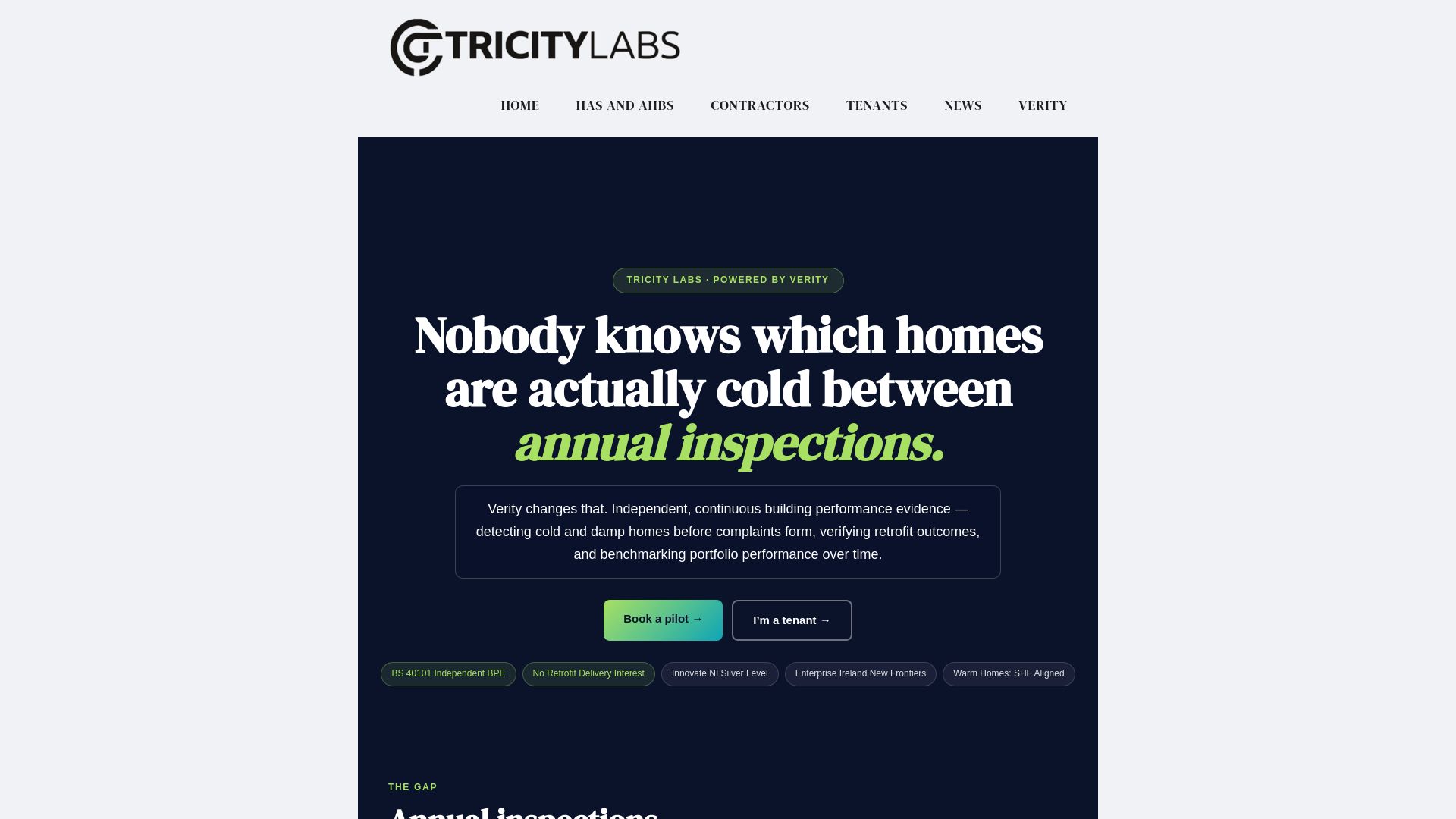
Tricitylabs' Verity platform is built specifically for that job. It continuously monitors temperature, humidity, and occupancy across your property portfolio, benchmarks performance at portfolio level, and produces the compliance-ready reports your team needs for regulatory submissions and funding applications. Data ownership stays with you, the platform is GDPR-compliant with UK data residency, and Tricitylabs' independence from retrofit delivery means the evidence it produces carries no conflict of interest.
To see how Verity performs across your property types, request a pilot or demo directly with the Tricitylabs team.
Sources
- Data Loggers and Recorders For Humidity and Temperature
- Temp Stick® by Ideal Sciences — Official Website
Recommended
- News & Updates | Tricity Labs Platform developments, regulatory milestones, and insights from the intersection of energy, housing, and fintech — from the Tricity Labs team. - Tenant Engagement - TRICITY LABS
- Tricity Labs | Independent Retrofit M&V for Housing Associations and Contractors
- Contractors - Tenant Engagement - TRICITY LABS
Created with BabyLoveGrowth to grow search and AI visibility